
Why Spreadsheets Are Failing Inspection & Compliance Operations in India
Most inspection teams do not fail because inspections are not being conducted consistently.
They fail because the follow-through after inspections begins to break down over time.
Across manufacturing units, facilities, infrastructure projects, and compliance-driven industries in India, inspections are carried out every single day with discipline and intent.
Checklists are carefully filled out.
Observations are properly recorded.
Issues are clearly identified.
But what happens after that is where the real operational problem starts to surface.
Because in most organizations, the challenge is not inspections themselves.
> The challenge lies in the system that supports them.
The Real Problem Isn’t Inspections — It’s What Happens After Them
On the surface, operations often appear to be under control and functioning smoothly.
Inspections are completed on schedule.
Teams are actively doing their work.
Data is being captured and stored.
However, when you take a closer look at how information flows:
- Inspection data is stored across multiple spreadsheets
- Issues are tracked informally through emails or messaging apps
- Work orders are handled in separate, disconnected tools
- Follow-ups rely heavily on manual reminders and human memory
Everything exists in some form.
But nothing is truly connected or synchronized.
And when systems are disconnected, operations don’t just slow down—they become fragile, inconsistent, and difficult to manage at scale.
If Your System Looks Like This, You Already Have a Problem
If your team is currently managing inspections, assets, and work orders across:
- Excel sheets maintained by different teams
- Email threads that are difficult to track
- Paper-based records stored physically
- Messaging platforms like WhatsApp for updates
Then the issue is not a lack of effort or commitment.
It is a lack of system-level control and integration.
Because without a unified system:
- No one has a complete, real-time view of operations
• Ownership of tasks and issues becomes unclear
• Follow-ups are often delayed or missed entirely
• Issues tend to remain open longer than expected
And the most critical risk?
You usually realize these gaps only when something goes wrong.
The Hidden Cost of “Managing It Somehow”
Many teams operate under the assumption that they are managing operations effectively.
But in reality, what they are doing is:
> Managing operational gaps manually, every single day.
These gaps are not immediately visible or alarming.
They build gradually over time.
A missed follow-up in one location.
An outdated record in another.
A delayed action somewhere else.
Until eventually, these small inefficiencies accumulate and show up as:
- A compliance failure during an audit
- A safety incident on-site
- A disruption in production or operations
- Or a serious observation raised during inspections
At that point, the cost is no longer operational.
It becomes financial, reputational, and regulatory.
What This Creates in Real Operations
When you observe real-world operations closely, the impact becomes very clear:
- Issues remain unresolved for longer than expected due to lack of tracking
- Repeat failures occur because earlier issues were not fully closed
- Asset condition begins to affect production continuity and efficiency
- Teams spend more time tracking information than solving problems
- Audit preparation becomes reactive, stressful, and time-consuming
> This is how operational risk quietly builds in the background.
Not because teams are careless or inefficient.
But because the systems they rely on are not designed to support structured execution.
Why Spreadsheets Break in Compliance Environments
Spreadsheets are flexible and widely used tools.
But they were never designed to handle:
- Recurring inspection schedules across multiple sites
- Complete lifecycle tracking of issues and corrective actions
- Linking inspections directly to work orders and follow-ups
- Ensuring accountability across different teams and roles
- Maintaining structured, audit-ready documentation over time
Spreadsheets are excellent at storing data.
But they are not built to drive operational execution.
And in compliance-driven environments, execution is what truly matters.
The Real Gap: From Inspection to Action
Many organizations assume that:
“If we have recorded the inspection, we are covered.”
But compliance does not work that way.
True compliance requires:
- Proof that inspections were conducted
- Proof that issues were identified correctly
- Proof that corrective actions were initiated
- Proof that those actions were completed
And most importantly:
> Proof that nothing was missed during the process.
This is where spreadsheets fall short.
They can show data entries.
But they cannot demonstrate control, continuity, or accountability.
Where Zamorin Solutions Fits In
Most generic software solutions require teams to change how they work.
Zamorin Solutions is built specifically for inspection-driven, compliance-heavy operations in India.
It is designed around real workflows, not theoretical processes.
It connects:
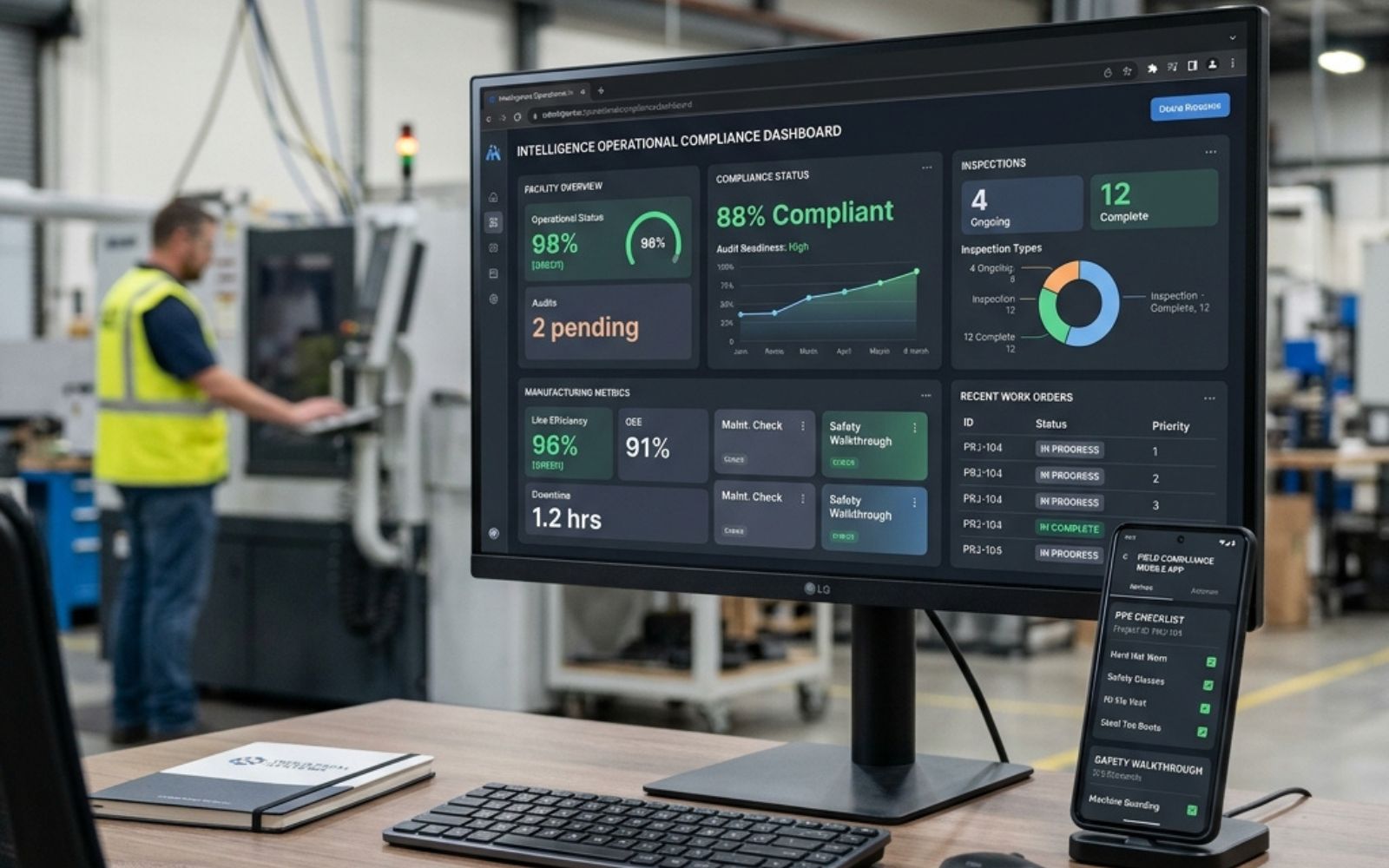
- Inspections conducted in the field
- Assets being monitored
- Issues identified during checks
- Work orders assigned for action
- Follow-ups required for closure
Into one unified and structured system.
So that:
- Every inspection naturally leads to a defined action
• Every issue is tracked consistently until closure
• Every activity is automatically recorded
• Every record is instantly available when required
Not just as reports. But as verifiable proof.
This Is Not About Software — It’s About Control
When inspections, issues, and work orders are integrated into a single system, several key improvements take place:
1. Visibility Becomes Immediate and Real-Time
Leaders no longer have to wait for updates or reports.
They can see what is happening across all locations instantly.
2. Follow-Ups Become System-Driven
There is no longer a dependency on manual reminders or memory.
The system ensures that every issue progresses toward closure.
3. Accountability Becomes Clear and Measurable
Every task is assigned to a specific individual.
Every issue has a defined status.
Every action is tracked transparently.
4. Audits Become Structured and Predictable
There is no need for last-minute data gathering.
All records are already organized and accessible.
5. Teams Focus More on Work and Less on Tracking
Less time is spent updating spreadsheets or chasing information.
More time is spent solving real operational problems.
What Actually Changes When Systems Are Connected
Many organizations believe they need:
- Better reporting tools
- More advanced dashboards
- Improved tracking mechanisms
But these are not the core problem.
The real need is control over operations and outcomes.
Control means:
- Knowing exactly what has been completed
- Knowing what is still pending
- Knowing what carries risk
- Knowing what requires immediate attention
And most importantly:
Being able to prove all of the above at any given time.
The Risk Most Teams Underestimate
The most common mistake organizations make is underestimating the cost of delays.
Delays often appear manageable at first.
They do not seem critical or urgent.
Until:
- An issue is not resolved within the required timeframe
- An audit reveals missing or inconsistent records
- A previously identified problem repeats itself
At that point, the impact escalates quickly into:
- Financial penalties and fines
- Operational downtime and disruptions
- Compliance risks and regulatory scrutiny
- Damage to reputation and trust
Why This Matters More in India
In India, inspection and compliance processes are:
- Highly regulated
- Frequently audited
- Documentation-intensive
- Increasingly scrutinized
Organizations are not only expected to comply.
They are expected to prove compliance consistently.
This means:
You cannot just perform the required tasks.
You must also demonstrate that they were completed correctly and fully.
Final Thought
Most teams believe they need better tracking systems.
They don’t.
They need stronger and more reliable follow-through mechanisms.
If your operations still depend heavily on spreadsheets,
you are not just managing data.
You are managing delays and uncertainty.
And in compliance-driven environments:
delays eventually become risk
and risk eventually becomes cost
The real question is not whether you should digitize your operations.
It is how long you can afford to continue without it.
—————————————————————————————
Come visit the Parkzapp booth #2459, 𝗡𝗥𝗣𝗔 𝟮𝟬𝟮𝟲 Conference · 𝗦𝗲𝗽𝘁𝗲𝗺𝗯𝗲𝗿 𝟮𝟵𝘁𝗵· 𝗣𝗵𝗶𝗹𝗮𝗱𝗲𝗹𝗽𝗵𝗶𝗮, 𝗣𝗔. Play a game, grab a treat, and let’s have a real conversation
Frequently Asked Questions (FAQs)
- Why are spreadsheets not suitable for inspection management?
-
Spreadsheets can store inspection data, but they cannot track issue lifecycle, automate follow-ups, or ensure accountability. This makes them unreliable for compliance-driven operations.
- What is inspection management software in India used for?
-
Inspection management software helps organizations digitize inspections, track issues, manage work orders, and maintain audit-ready records in a structured and centralized system.
- How does Zamorin Solutions improve compliance tracking?
-
Zamorin Solutions connects inspections, issues, and work orders into one system, ensuring every activity is tracked, documented, and available as proof during audits.
- What are the risks of managing inspections manually?
-
Manual systems lead to missed follow-ups, delayed actions, poor visibility, and increased audit risk, which can result in compliance failures and operational disruptions.
- How can organizations improve inspection follow-through?
-
By adopting a connected system that links inspections to actions, automates tracking, and provides real-time visibility, organizations can ensure every issue is resolved and documented properly.
Related Posts
Why Compliance Breaks Before Audits, and How Visibility Fixes It
Audits don’t usually create problems. They reveal them. A missing inspection record. A delayed corrective…
Why Custom Software Development Is the Growth Engine for Indian Startups and SMEs in 2025
Table of Content Introduction: The Rise of Tailored Tech What Is Custom Software Development? Why…
Top 5 AI Tools Every Software Company Should Adopt This Year
Artificial intelligence (AI) is no longer merely a buzzword. For software firms looking to increase…
The Role of Custom Software in Driving Business Growth
Think your generic software will keep pace with your expanding business? Think again. In India’s…