

The Clipboard Isn’t the Problem. The Lack of Visibility Is.
Walk into almost any factory, industrial facility, warehouse, or commercial operation and you’ll see teams doing the right things.
Inspections are happening.
Maintenance teams are working.
Assets are being serviced.
Work orders are being created.
On the surface, everything appears under control.
Yet when operational leaders ask a simple question:
“What is the current status across all locations?”
The answers often become difficult to find.
One spreadsheet says one thing.
A maintenance supervisor reports another.
WhatsApp messages contain additional updates.
Leadership waits for reports that may already be outdated.
The clipboard isn’t the problem.
The problem is that critical operational information remains disconnected.
And when visibility breaks, operational risk begins to build.
The Hidden Challenge in Multi-Location Operations
Managing one facility is difficult.
Managing ten, twenty, or fifty facilities introduces a completely different challenge.
Every location generates:
Inspection records
Maintenance requests
Asset updates
Compliance activities
Vendor interactions
Corrective actions
Work orders
As operations expand, information grows faster than visibility.
Many organizations continue relying on:
Excel spreadsheets
Emails
WhatsApp groups
Paper forms
Standalone databases
These tools work individually.
Together, they create operational silos.
And operational silos create operational blind spots.
Where Visibility Breaks Down
Across industrial operations, the same patterns appear repeatedly.
1. Manual Follow-Up Dependency
An issue is identified.
A corrective action is assigned.
Progress depends on reminders, calls, and follow-ups.
Visibility relies on people rather than process.
2. WhatsApp-Based Coordination
Updates are shared.
Photos are exchanged.
Tasks are discussed.
But information becomes difficult to track over time.
3. Excel-Based Records
Inspection histories
Asset details
Maintenance records
Compliance logs
All exist, but not necessarily together.
4. Delayed Work Order Closure
Work orders are created.
But status updates are often difficult to track.
Managers spend time asking for updates instead of seeing them.
5. Audit Preparation Stress
Audit readiness should be continuous.
Instead, many teams reconstruct records manually when audits approach.
This creates unnecessary pressure and risk.
The Cost of Limited Visibility
Most organizations measure maintenance costs.
Few measure the cost of poor visibility.
When visibility breaks:
Compliance pressure increases
Maintenance backlogs grow
Operational delays accumulate
Asset downtime increases
Accountability weakens
The issue is rarely effort.
Most teams work hard.
The issue is workflow visibility.
Why Traditional Facility Management Approaches Break Down
A common misconception is that more reporting creates more control.
In reality, excessive reporting often creates less visibility.
Managers spend time collecting information.
Teams update multiple systems.
Leadership receives information after issues have already escalated.
The pattern is familiar:
Inspections happen.
Issues are identified.
Work orders are created.
Visibility disappears between each stage.
The result is reactive management instead of proactive control.
From Maintenance Tracking to Operational Visibility

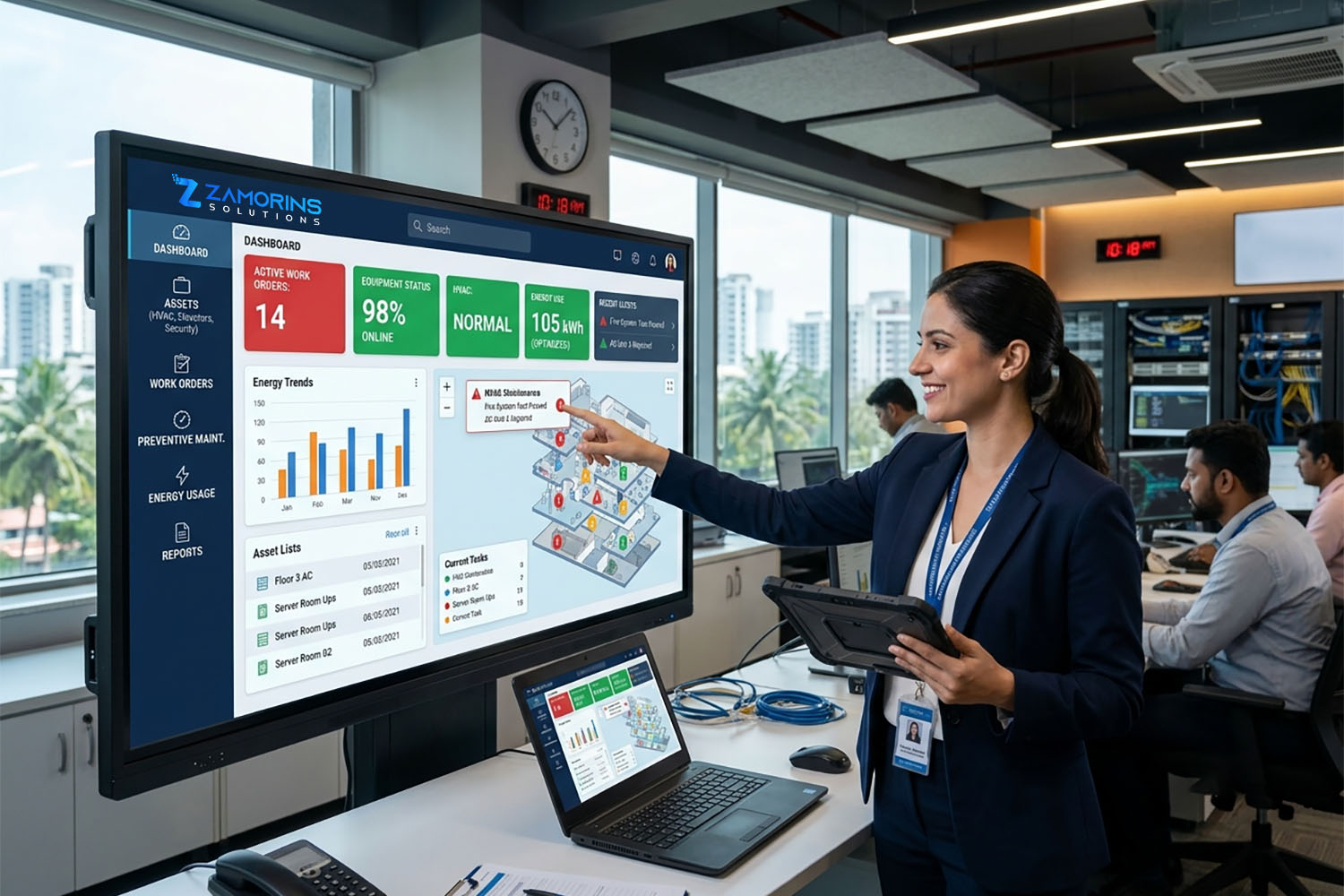
Modern facility management software does more than digitize records.
It connects:
Assets
Inspections
Work orders
Maintenance activities
Compliance records
Performance metrics
into one operational workflow.
The goal is not simply digitalization.
The goal is operational clarity.
When information remains connected:
Issues stay visible
Ownership becomes clearer
Decisions happen faster
Audits become easier
The Role of CMMS Software in Modern Operations
A Computerized Maintenance Management System (CMMS) helps organizations manage maintenance activities systematically.
Instead of relying on spreadsheets and memory:
Maintenance schedules become automated
Work orders become trackable
Asset histories become searchable
Performance becomes measurable
For multi-location businesses, this creates consistency across facilities.
No matter where an asset is located, its operational history remains visible.
How Zamorins Solutions India Helps Industrial Teams Improve Visibility
At Zamorins Solutions India, we help organizations connect:
Facility inspections
Asset management
Work order tracking
Maintenance workflows
Compliance activities
into one connected operational environment.
The objective is simple:
Ensure every issue remains visible from identification through closure.
Because visibility drives accountability.
And accountability drives operational performance.
Before vs After Operational Visibility
Before
Paper-based inspections
Spreadsheet-driven reporting
WhatsApp coordination
Delayed work order updates
Audit preparation stress
Limited multi-site visibility
After
Digital inspections
Connected workflows
Real-time dashboards
Work order visibility
Audit-ready records
Better operational control
The difference is not simply technological.
It is operational.
Strategic Insight
The future of facility management is not about collecting more data.
It is about creating actionable visibility.
Organizations that improve visibility across inspections, assets, work orders, and compliance activities gain a significant operational advantage.
Not because they have more information.
Because they can act on it faster.
The clipboard has served facility operations for decades.
But today’s operational challenges require more than record keeping.
Multi-location organizations need visibility across facilities, teams, assets, and workflows.
They need systems that reduce complexity rather than add to it.
They need information that drives action.
Because the goal is not simply to digitize maintenance.
The goal is to create smarter, more connected operations that scale with the business.
Can Your Team Answer These Questions Instantly?
✓ Which work orders are still open?
✓ Which corrective actions are overdue?
✓ Which facilities have recurring maintenance issues?
If not, visibility may be creating more operational risk than you realize.
Discover how Zamorins Solutions India helps organizations improve inspections, maintenance management, asset visibility, and operational control across every location.
Frequently Asked Questions (FAQs)
What is facility management software?
Facility management software helps organizations manage inspections, assets, maintenance activities, work orders, and compliance requirements from a centralized platform.
How does CMMS software improve maintenance operations?
CMMS software automates maintenance scheduling, tracks work orders, stores asset histories, and provides visibility into maintenance performance.
Why do multi-location businesses need facility management software?
Multi-location operations generate large volumes of operational information. Facility management software centralizes data and improves visibility across locations.
What causes maintenance visibility gaps?
Disconnected systems, spreadsheets, manual updates, and fragmented communication often prevent leaders from gaining real-time visibility into maintenance activities.
How does facility management software support compliance?
It maintains digital inspection records, maintenance histories, work order documentation, and audit trails that help organizations improve compliance readiness.
Which industries benefit from facility management software?
Manufacturing, logistics, healthcare, education, commercial facilities, warehousing, and industrial operations all benefit from improved visibility and workflow management.
Related Posts

Predictive Maintenance Software to Reduce Downtime
Most Equipment Downtime Doesn’t Begin With Equipment Failure It begins with information failure. A technician…
How Real-Time Operations Software Dashboards Help Manufacturing Leaders Make Better Decisions
Better Decisions Don’t Start in the Boardroom. They start on the shop floor. A production…

Why Every Business Needs a Custom Mobile App in the Digital Age
Table of Content What Is a Custom Mobile App? Why Should Businesses Care About Mobile…