Facility operations are not failing because teams are careless.
They fail because information is scattered.

Across Indian manufacturing plants, warehouses, campuses, and multi-site facilities, inspections happen every day. Maintenance is scheduled. Work orders are raised. Compliance boxes are ticked.

Yet leaders still struggle to answer simple questions:

  • What’s pending right now?

  • Who owns this issue?

  • Has it actually been closed?

  • Are we audit-ready today?

The work happens.
The visibility breaks.

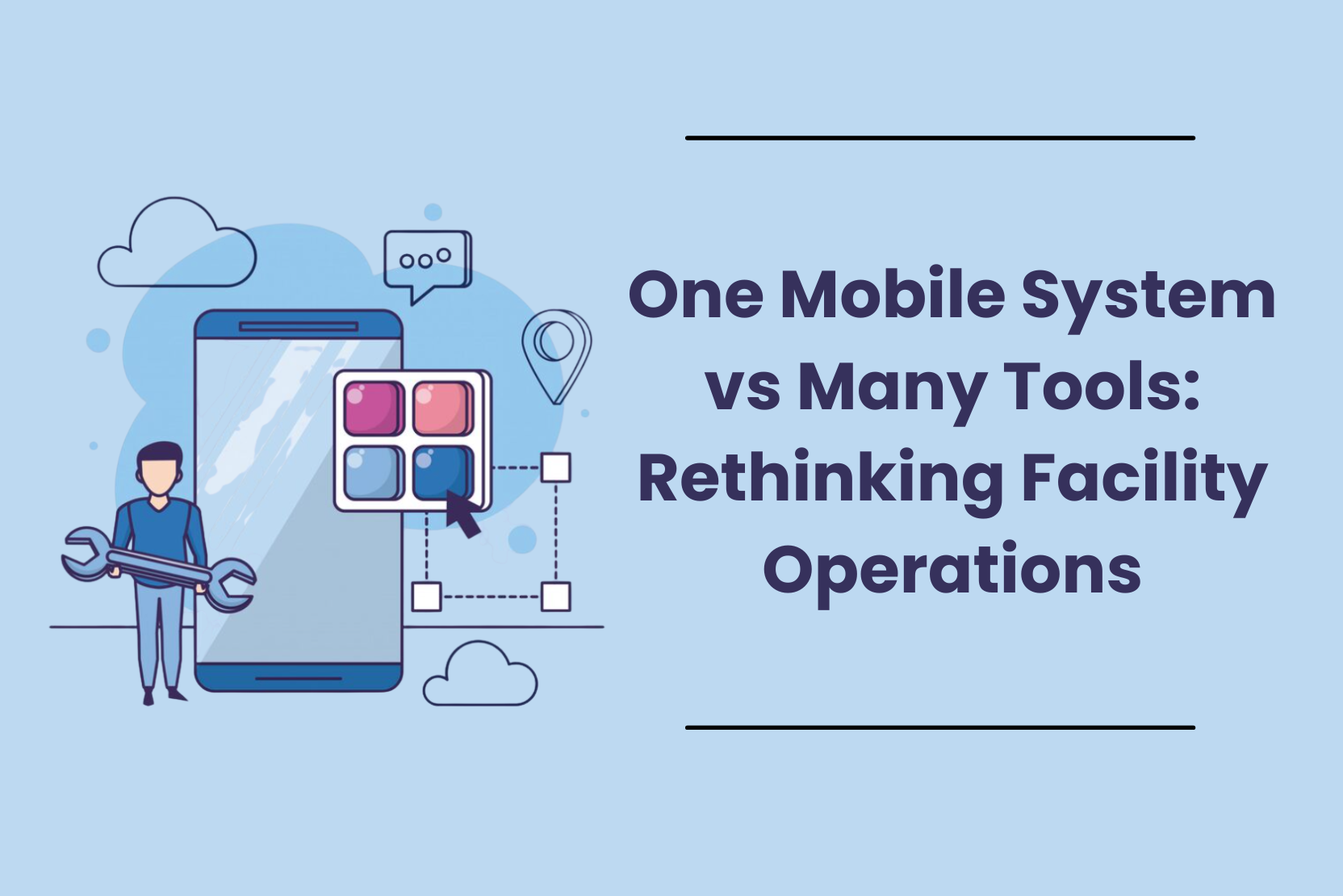
This guide explains why many tools create more risk than no tools at all, and why forward-looking facilities are shifting toward one mobile system that teams actually use.

Why do facility teams rely on so many tools?

Because problems were solved one at a time.

A spreadsheet for inspections.
WhatsApp for updates.
Email for approvals.
Paper logs for audits.
Photos are stored on personal phones.

Each tool made sense in isolation. Together, they created chaos.

Most facilities didn’t design fragmented operations they inherited them. Over time, the tool stack grew, but clarity did not.

Result: No single source of truth.

How do fragmented systems increase operational risk?

Operational risk rarely comes from a missed task.
It comes from missed context.

  • A safety issue is logged, but the photo is lost.

  • A work order is issued, but ownership is unclear.

  • An inspection passes, but trends are invisible.

  • An audit arrives, but the records are scattered.

When systems don’t talk to each other, risk hides between them.

As Nandan Nilekani said,

“Technology is a great enabler, but only when it simplifies complexity.”

Multiple tools do the opposite.

What breaks when inspections go digital but data stays scattered?

Digitizing inspections alone is not a transformation.

If:

  • Inspection data lives in one app

  • Assets in another system

  • Work orders in spreadsheets

  • Reports in PDFs

The decision-making still depends on manual follow-ups.

Leaders gain data, but lose visibility.

True digitization connects the entire lifecycle:
Inspect → Identify → Assign → Resolve → Verify → Report

Why is mobile-first field data capture critical?

Because facilities don’t operate at desks.

Field teams need to:

  • Capture data on-site

  • Add photos instantly

  • Log issues while they’re visible

  • Update status without returning to an office

Mobile-first systems reduce delays, eliminate paperwork, and improve accuracy.

If data entry happens after the work, it’s already outdated.

How does a single system improve accountability?

When everything lives in one system:

  • Every issue has an owner

  • Every task has a status

  • Every delay is visible

  • Every closure is verifiable

No more:

  • “I thought someone else handled it.”

  • “I sent it on WhatsApp.”

  • “It’s in an Excel somewhere.”

Accountability stops being personal and becomes systemic.

Can one platform adapt to regulations and audits?

Yes, if it’s custom-built around real workflows.

Indian facilities deal with:

  • Changing safety regulations

  • Client-specific audit formats

  • Site-level variations

  • Scale across locations

Off-the-shelf tools force teams to adapt to software.
Custom systems adapt to how work actually happens.

That flexibility is what keeps teams compliant without slowing them down.

Does consolidation slow teams down or speed them up?

It speeds them up when done right.

A single system:

  • Reduces duplicate data entry

  • Eliminates follow-up calls

  • Shortens approval cycles

  • Improves reporting accuracy

Less chasing.
More doing.

Teams don’t want more software.
They want fewer steps.

What should facilities digitize first?

Start where friction is highest:

  • Safety inspections
  • Preventive maintenance
  • Asset tracking
  • Incident reporting

Choose one process.
Design it end-to-end.
Then scale.

Digital transformation works best when it’s incremental, not overwhelming.

Key Takeaways for Facility & Operations Leaders

  • Operational risk grows when data is fragmented


  • Multiple tools create blind spots, not efficiency


  • Mobile-first systems reduce delays and errors


  • One platform improves accountability and audit readiness


  • Custom workflows scale better than generic software


  • Start small, then expand across operations

Final Thought

This is not about adding another system.

It is about replacing many tools with one system that teams trust and actually use.

If you could digitize one inspection or maintenance process this quarter, which one would it be?

Related Posts